Toyota RAV4 PHEV gains 150 km of electric range and a GR Sport version
 By Arthur Berg
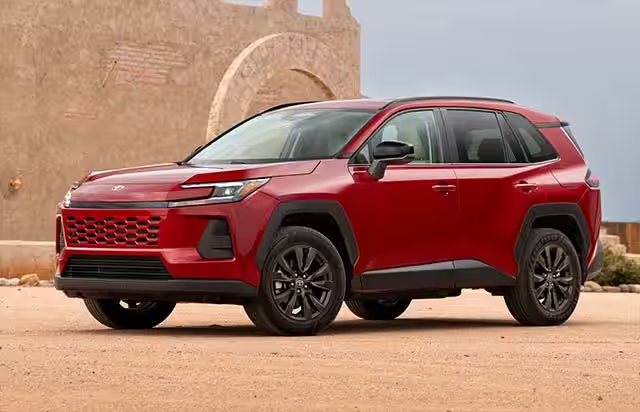
Toyota has confirmed that the new RAV4 Plug-in Hybrid will go on sale in Japan starting March 9, 2026. The headline feature is a boosted electric-only range up to 150 km, coupled with a peak system output of 242 kW (329 hp). To top it off, there’s also a sporty GR Sport variant coming to the lineup.
Up to 150 km electric range and 242 kW power
The updated RAV4 PHEV now offers as much as 150 km of electric range, a significant leap from the previous 95 km. This improvement is thanks to a new high-capacity battery pack and power electronics based on silicon carbide (SiC) technology. With 150 km on electric power alone, this model is among the segment’s leaders for real-world battery range – enough to cover most daily drives without ever firing up the gasoline engine.
- Electric-only range: up to 150 km (92 miles)
- Maximum combined output: 242 kW (329 hp)
- Supports high-power charging
Toyota touts “world-leading energy efficiency” in its press materials – a marketing claim, sure, but the combination of SiC semiconductors and a bigger battery genuinely boosts efficiency in daily use: more kilometers on electric power, fewer stops at the pump for typical urban drivers.
External power supply and emergency backup for up to 7 days
Beyond driving, the RAV4 PHEV doubles as a mobile power source. A 100 V external outlet (up to 1,500 W) is built into the trunk and accessible through the charging port, ideal for camping, work sites, or temporary blackouts.
Toyota estimates that at a 400 W load, the vehicle can supply power for around 6.5 days in HV Power Supply Mode; prioritizing duration extends that to as much as 7 days. These figures position the RAV4 PHEV not just as an SUV, but as a practical emergency tool-an especially compelling feature in earthquake-prone Japan, where power outages are a real concern.
New GR Sport model
The lineup also welcomes a GR Sport variant, featuring motorsport-inspired styling and chassis upgrades. Enhancements include a front lip spoiler, rear wing, GR Performance dampers, reinforced GR strut braces, recalibrated suspension, and a lower center of gravity thanks to battery integration.
Toyota says the aerodynamic elements were fine-tuned using CFD simulations and wind tunnel testing to maintain stability at various speeds. This isn’t just a cosmetic package – engineers focused on handling improvements, which could make a noticeable difference in driving dynamics for a PHEV with a heavy battery low in the chassis.
Price and sales outlook in Japan
Toyota expects to sell around 700 PHEVs monthly in Japan. Official prices including tax are:
- RAV4 PHEV Z: ¥6,000,000 (~$38,700)
- RAV4 PHEV GR Sport: ¥6,300,000 (~$40,650)
These prices are higher than those of standard hybrid RAV4 models, but that’s expected in the plug-in hybrid segment. The larger battery and independent electric range make the PHEV less fuel-dependent and attractive for buyers seeking the “best of both worlds” – electric driving in the city and a gasoline engine for longer trips.
What’s next for the RAV4 PHEV
While this announcement is currently Japan-only, Toyota hasn’t ruled out rolling out similar updates in other markets. It’s a sign the company continues to invest heavily in PHEVs alongside its fully electric offerings – a strategy aimed at adapting to varied infrastructure and regulatory environments worldwide.
Competitors in the plug-in hybrid SUV arena-like the Mitsubishi Outlander PHEV and the European versions of the Ford Kuga/Escape PHEV-will now face stiffer competition in terms of electric range and utility. Unless rivals respond with bigger batteries and external power features, the RAV4 PHEV could capture a significant share of buyers seeking a practical, electrified SUV that bridges the gap between electric and traditional fuel.
Sales kick off on March 9, 2026 in Japan. The big question remains how well this updated PHEV will sell overseas and how quickly competitors will raise the bar in the segment. What’s clear: the RAV4 PHEV has evolved from “just a hybrid” into a versatile tool straddling the worlds of transportation and energy supply.