The James Webb telescope has discovered an unexpected variety of cosmic dust in the dwarf galaxy Sextans A
 By ForGeeks
Astronomers using the James Webb telescope have discovered a chemically primitive galaxy that produces dust. This is unusual, given that the galaxy lacks the necessary components to do so. The discovery provides a better understanding of how early galaxies evolved and formed dust.
The discovery also provides a better understanding of how early galaxies evolved and formed dust.
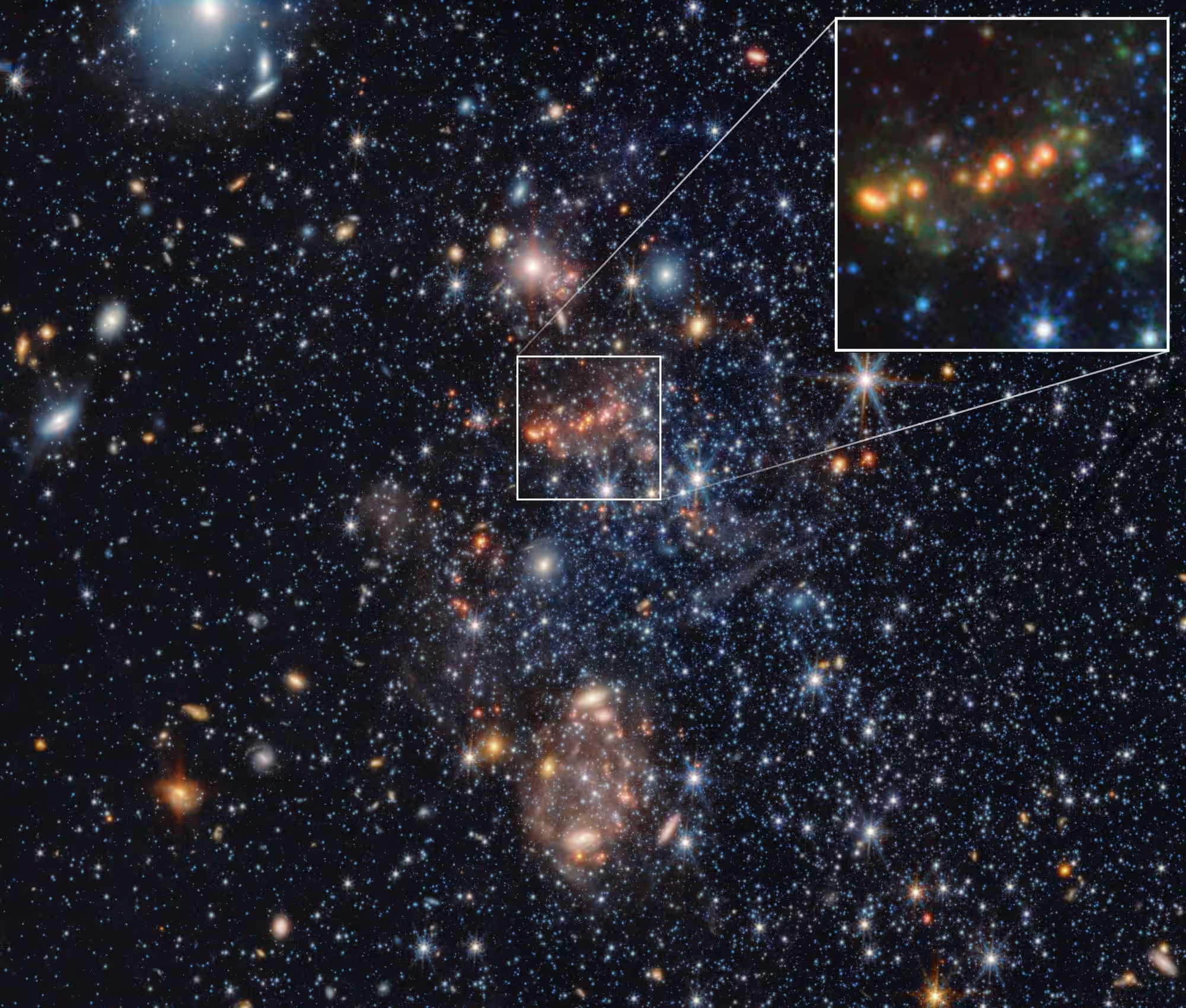
The galaxy in question is Sextans A — a dwarf galaxy located about 4 million light-years from Earth. It has an extremely low metallicity, with only three to seven percent of the elements heavier than hydrogen and helium at the level of the Sun. In astrophysics, metallicity refers to these heavy elements. In its characteristics, Sextans A resembles galaxies that existed in the early universe.
According to current thinking, the early universe was almost entirely filled with hydrogen and helium. Heavier elements such as carbon, oxygen, silicon and iron formed later in the interior of stars and spread through space in supernova explosions. This is how astronomers have long explained the evolution of the universe’s chemical composition.
But two recent linked studies supported by the James Webb Space Telescope have shown that the picture may be much more complicated. Scientists found metallic iron dust in Sextans A, as well as silicon carbide formed by dying stars. One of these studies was published in the Astrophysical Journal and reported a star forming dust grains composed almost entirely of iron. This came as a surprise, given the extremely metal-poor composition of the galaxy.
The study also found that the star formed dust grains almost entirely of iron.
In addition, some stars in Sextans A turned out to be sources of silicon carbide (SiC). Both iron dust and silicon carbide were created by so-called asymptotic giant branch stars (AGB stars). These are highly inflated luminaries, late in their evolution, that actively eject matter into the surrounding space.
A second study, still undergoing peer review, has revealed the presence of polycyclic aromatic hydrocarbons (PAHs). These large and complex carbon-based molecules were previously thought unlikely to be present in galaxies with such low metallicity. Telescope observations have shown that PAHs are present in small, dense regions only a few light-years in size. This means that such molecules are able to form and persist even when heavy elements are scarce.
Taken together, the two studies suggest that there were many more mechanisms for the formation of cosmic dust in the early universe than astronomers had previously assumed. These findings force a rethinking of how and under what conditions complex matter formed in the early Universe.