OpenAI launches Prism — a free AI-powered research environment for scientific writing
 By Arthur Berg
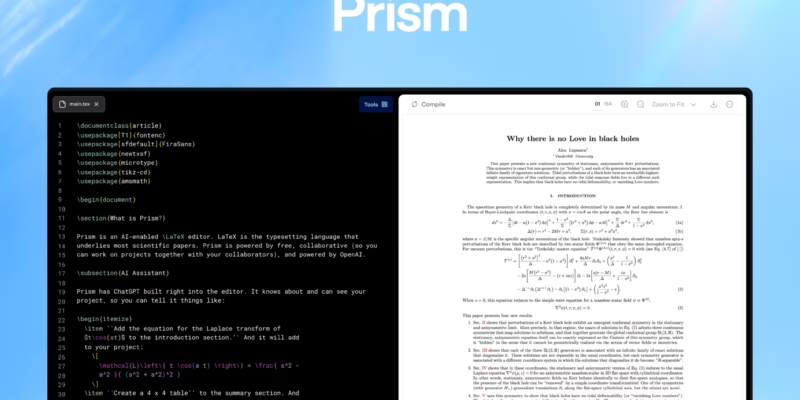
OpenAI unveiled Prism on Tuesday, a new AI-driven research tool designed as a free, all-in-one scientific writing environment accessible to anyone with a ChatGPT account. Built as an AI-enhanced text editor and research assistant, Prism integrates deeply with the GPT-5.2 model, enabling users to fact-check claims, edit scientific manuscripts, and explore previous research.
Prism is not intended to replace human researchers or conduct independent studies. According to OpenAI leadership, its purpose is to speed up scientists’ workflows, not substitute them. It’s been compared to programming interfaces like Cursor and Windsurf, which boost productivity by embedding AI seamlessly into everyday tasks.
“I believe 2026 will be for AI and science what 2025 was for AI and software development,” said Kevin Weil, OpenAI’s VP of science, during the press conference.
Prism runs as a web app and arrives amid surging scientific queries across OpenAI’s consumer products, including ChatGPT. OpenAI reports that ChatGPT receives roughly 8.4 million messages weekly on complex subjects in exact and natural sciences, though it’s challenging to identify how many come from professional researchers.
AI’s role in academia is growing rapidly. In mathematics, AI models have already been used to prove several longstanding Erdős problems by blending analysis of existing literature with novel applications of known methods. While the significance of these proofs remains debated, their outcomes provide compelling evidence for AI-powered formal verification systems.
In December, a research paper in statistics showcased GPT-5.2 Pro helping to derive new proofs for one of the core axioms of statistical theory. Human involvement was limited to task formulation and result verification. OpenAI highlighted this milestone on their blog as a promising example of human-AI collaboration in scientific research.
The company’s publication notes that in fields with axiomatic theoretical foundations, state-of-the-art AI models can assist with proof exploration, hypothesis checking, and uncovering connections that would take humans far longer to detect.
A major part of Prism’s value lies in advancing existing standards. The tool integrates with LaTeX — the open-source typesetting system widely used for scientific papers — but offers far more capabilities than most LaTeX editors. It also leverages GPT-5.2’s visual features, allowing users to create diagrams from sketches on an online whiteboard, a feature traditionally tricky in standard tools.
One of Prism’s standout features is enhanced context handling. When users open a ChatGPT window inside Prism, the model gains full access to the entire research project’s context, making responses far more relevant and meaningful.
While experienced users could theoretically achieve similar results by interacting directly with GPT-5.2, OpenAI expects Prism’s cleaner, more user-friendly interface to accelerate adoption among scientists. According to Kevin Weil, this mirrors the same factors that made AI so impactful in software development.
“Software development sped up not just because of powerful models,” he explained, “but also thanks to the deep integration of AI into workflows.”