DeepSeek unveiled new open-source models, claiming advantages over GPT-5 and Gemini 3 Pro
 By ForGeeks
Barely a year after a high-profile debut that noticeably impacted the global AI market, China’s DeepSeek is back with two new models — and some very loud claims. According to the company, their new open-source designs, DeepSeek V3.2 and V3.2-Speciale, are capable of matching or even surpassing the most powerful AI systems on the market, including OpenAI’s GPT-5 and Google’s Gemini 3 Pro.
Rather than endlessly increasing computing power, DeepSeek continues to pursue an efficient architecture strategy. While U.S. labs use huge clusters of the latest chips, DeepSeek says its optimized learning approach can achieve comparable levels of intelligence on more affordable hardware. The company also notes that even the basic version of the model supports built-in reasoning mechanisms and is able to work with tools without going into a separate reasoning mode.
An optimized version of the model can be used to train tools without going into a separate reasoning mode.
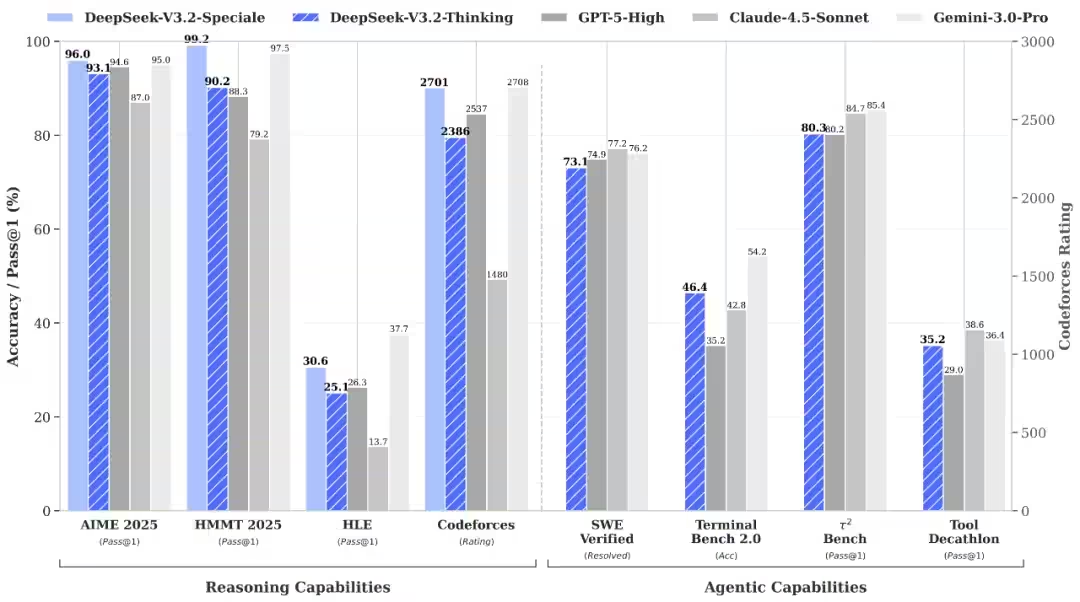
The main focus is on the V3.2-Speciale model. DeepSeek claims that it outperformed the GPT-5 in internal tests and shows the level of the Gemini 3 Pro in tasks requiring complex reasoning. As proof, the company cites results in international Olympiads — in math and computer science, with published solutions available for verification.
The company cites the Gemini 3 Pro’s performance in international Olympiads — in math and computer science, with published solutions available for verification.
The performance gains, according to DeepSeek, are based on two key innovations: a proprietary sparse attention engine optimized for processing long contexts, and an enhanced reinforcement learning loop with more than 85,000 complex step-by-step tasks created through an internal «agent-based task synthesis» system.
The DeepSeek V3.2 model is already available on the company’s website, in mobile apps and via API. The more experimental V3.2-Speciale version is only available through a temporary API point that will be closed after December 15, 2025. Right now, it works as an engine for reasoning tasks and does not support tool invocation.