Tesla patents Starlink satellite-enabled car roof

 By Arthur Berg
Tesla has filed a patent application in the U.S. and Europe for a new car roof design that could point to the possible integration of satellite communications into the company’s electric vehicles. The document has already sparked discussion in the industry as it potentially paves the way for satellite internet directly in cars.
The document has already sparked discussion in the industry as it potentially opens the way for satellite internet to be used directly in cars.
On Dec. 4, Tesla registered patent application No. 2025/0368267 in the United States. The document describes a development called “Vehicle Roof Assembly with Integrated RF Transparency for Electronic Module Consolidation” – a vehicle roof assembly with integrated RF transparency for electronic module consolidation. The application was brought to the attention of X user Chansoo Byeon, which led to speculation in specialized communities about the possible integration of Starlink satellites into Tesla’s electric cars.
What the patent describes
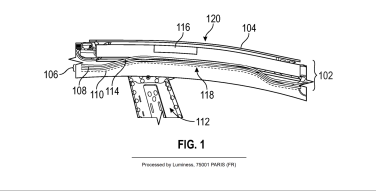
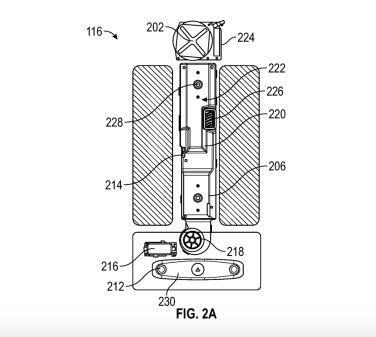
The copy of the patent filed with the European Patent Office contains several technical diagrams of the intended roof structure, as well as a detailed textual description and list of components. The U.S. version of the patent is indexed on Google, but at the time of publication is not available to view via a browser.
According to the description, the roof structure involves the use of an outer panel of radio frequency transparent polymeric materials. Polycarbonate (PC), acrylonitrile-butadiene-styrene (ABS), and acrylonitrile-styrene-acrylate (ASA) are listed as examples. These materials allow radio frequency signals to pass freely through the roof of the vehicle.
In some embodiments, the design provides for overhead electronic modules to be placed directly inside the roof. This includes antennas that can communicate directly with external devices and satellites. Additionally, the description mentions a “membrane effect” to increase passenger protection in the event of an impact, as well as the use of integrated foam between the outer roof panel and the inner skin. This should improve the cabin’s thermal and acoustic insulation.
At the same time, it’s also said to have a “membrane effect” to improve occupant protection.
Why it’s gotten attention
Tesla’s electric cars already use cellular connectivity for navigation, multimedia, and software updates. But integrating a satellite dish directly into the car’s design could provide internet access almost anywhere, regardless of cellular network coverage.
The publication Electrek notes that the metal and glass roofs of modern cars can shield satellite radio signals. Tesla’s proposed design solves this problem by using a radio-frequency transparent membrane and potentially integrating the antenna into the roof itself.
According to Electrek, some Tesla owners are already installing Starlink Mini satellite antennas on their cars themselves. This indicates the existing interest in satellite communications in electric vehicles and the potential demand for such solutions.
Satellites and mobile networks in one car
With the combination of 5G cellular and satellite internet, Tesla cars could get a significantly higher level of connectivity than most cars on the market. This is especially true for traveling in remote regions where traditional cellular service is spotty or non-existent.
The Tesla cars could have a significantly higher level of connectivity than most cars on the market.
The patent application itself doesn’t directly mention Starlink, nor has Tesla made any official statements about plans to integrate satellite internet into production electric cars. It’s also worth bearing in mind that companies regularly file patents for technologies that never make it to mass production.
It’s also worth bearing in mind that companies regularly file patents for technologies that never make it to the mass production stage.
A glimpse into a possible future
The patent nonetheless gives a glimpse of the direction Tesla is considering for automotive technology. Integrating satellite connectivity at the body structure level could be one step toward truly always-connected cars that can stay online regardless of infrastructure.
Satellite connectivity could be one step toward truly always-connected cars that can stay online regardless of infrastructure.
Even if the described solution doesn’t appear in any upcoming production models, the patent demonstrates Tesla’s interest in expanding connectivity and combining automotive and satellite technologies into a single platform.