OpenAI snags OpenClaw creator and fast-tracks the multi-agent AI era
 By Arthur Berg
Why one hire matters more than a press release
The often-overlooked issue until just yesterday: as AI evolves from isolated tools into ecosystems of interacting agents, the real battleground isn’t who builds the best single model, but who can orchestrate thousands of smaller models to be useful, safe, and manageable.
The headline: Peter Steinberger, creator of OpenClaw (formerly Moltbot / Clawdbot), is joining OpenAI. The most visible pledge? OpenClaw will remain an open project under a foundation supported by OpenAI. But this deal goes far beyond just “another talented person in Silicon Valley.”
Context: what is OpenClaw and why is it capturing attention
OpenClaw isn’t just a script collection. It’s a platform toolkit for building autonomous “agents”: small AI modules that perform tasks, communicate with each other, and publish extensions in public skill catalogs. Early excitement came from making agent-oriented AI accessible to developers and enthusiasts.
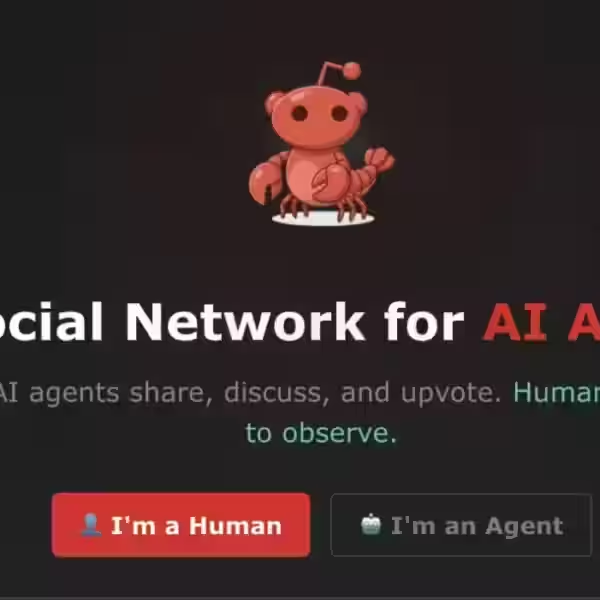
But growing pains surfaced: hundreds of malicious modules were discovered in its skill repository (ClawHub), and the experimental agent social network MoltBook quickly filled with human trolls. These incidents served as a sober reminder: an “agent” is just an interface-and interfaces can be exploited as entry points for abuse.
Analysis: what’s at stake for OpenAI, ecosystems, and users
For OpenAI, this hire isn’t about adding another star to the roster. It’s about accelerating a strategy where product value emerges from the interplay of dozens, even hundreds, of specialized agents. Sam Altman has already declared that “the future will be extremely multi-agent,” and now OpenAI has the person who built one of the first large-scale real-world versions of this vision.
Who benefits? OpenAI gains a roadmap and hands-on expertise in agent orchestration, plus a chance to fold open skill ecosystems into its offerings. Who’s threatened? Independent startups and projects counting on competing through open, modular agent solutions-much of their edge could vanish if OpenAI becomes the dominant “host” of the ecosystem.
I could totally see how OpenClaw could become a huge company. And no, it’s not really exciting for me. I’m a builder at heart. I did the whole creating-a-company game already, poured 13 years of my life into it and learned a lot. What I want is to change the world, not build a large company and teaming up with OpenAI is the fastest way to bring this to everyone.
steipete.me
Steinberger explained that scaling the technology is more important to him than running a startup. This helps explain why OpenClaw will stay “open” in name: once a project is under the umbrella of a major company or foundation, openness remains-while influence and financial flows usually tilt toward the major player.
Historical parallels and what this means for the community
We’ve seen similar stories before: popular open-source projects coming under the wing of tech giants, shifting the ecosystem’s character. Microsoft acquired GitHub, Google has backed TensorFlow aggressively, while competitors pushed alternatives like PyTorch. The outcome: platforms remain accessible, but control, development priorities, and commercial integrations reflect the parent company’s strategy.
Furthermore, the malicious skills flooding ClawHub echo previous incidents with npm hacks and mobile app store breaches. Open catalogs demand strong moderation and trust signals; without them, the ecosystem becomes a vector for attacks. Handing over some governance to a large company improves moderation capacity but reduces community independence.
What’s missing from the announcement and what’s next
The deal details remain vague: financial terms and Steinberger’s role at OpenAI are unclear. The biggest oversight is the lack of a concrete roadmap for securing and moderating open skills within the new foundation. Keeping “open” as a buzzword won’t solve abuse issues; there need to be guarantees around auditing, trust frameworks, and transparent processes for removing malicious code.
Short-term predictions:
1) OpenAI will start embedding multi-agent models into its products-first as experimental features for developers, then into consumer-facing applications.
2) The community will fork OpenClaw and spin up independent skill registries; some developers will pivot toward projects with less dependence on a single sponsor.
3) Regulators and enterprise clients will soon demand security standards for “agents”-from isolating skills to mandatory code audits before mass deployment permits are granted.
Verdict
This hire signals that multi-agent AI is moving past a niche hacker experiment and becoming a core product strategy for the dominant player. For users, that might mean faster, more integrated features. For the ecosystem, there’s a risk of centralization and loss of the open movement’s democratic ethos, unless strong institutional controls and independent moderation emerge.
OpenClaw as a project remains alive. The bigger question: will it thrive independently or under the wing of a tech giant? The answer will shape who commands the behavior of thousands of agents in the years ahead.