The most powerful solar radiation storm in 22 years hits Earth

 By ForGeeks
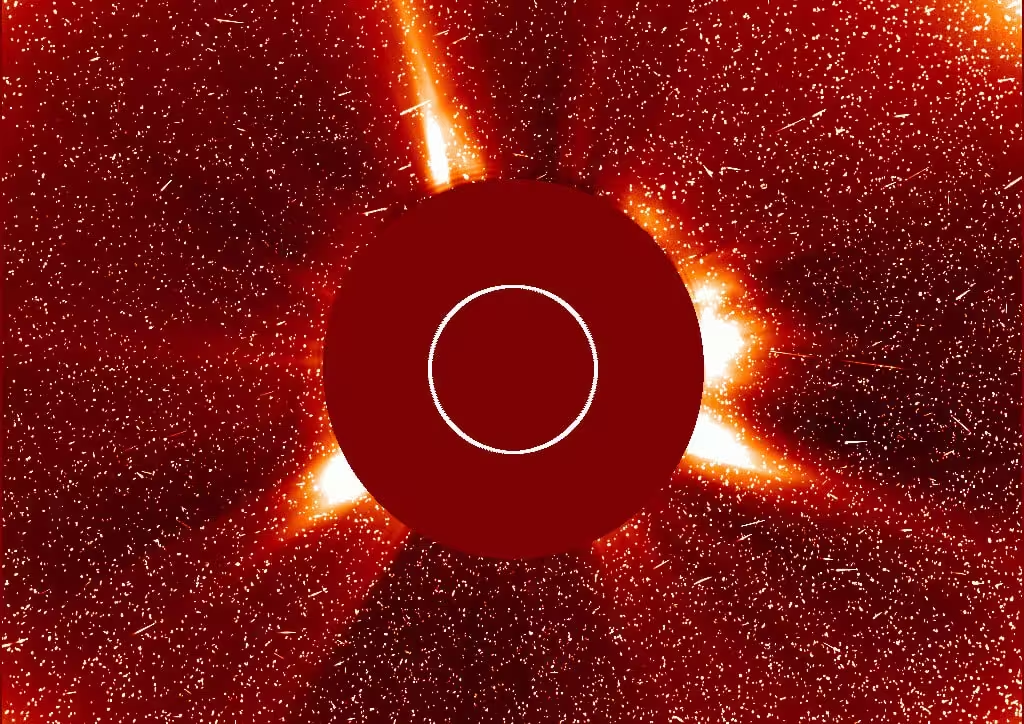
Scientists have detected an S4-level radiation storm, the most powerful since 2003. The flux of solar protons exceeded 37,000, a record for the 21st century.
- The flux of particles with energies above 10 MeV reached 37,000 pfu on the evening of January 19, 2025
- The speed of the solar wind was about 1,700 km/s
- The previous similar storm was observed in October 2003 at flare X17.2
Officers of the Solar Astronomy Laboratory of the Space Research Institute of the Russian Academy of Sciences and the Institute of Solar-Terrestrial Physics of the Siberian Branch of the Russian Academy of Sciences have recorded extreme indicators of solar activity. The flux of particles with energies greater than 10 MeV passed the 10,000 pfu mark and continued to increase. By the evening of January 19, the value exceeded 30,000 units and later reached 37,000 pfu.
Similar radiation levels were last recorded in October 2003. At that time, the X17.2 class flare triggered the largest magnetic storm of the current century. The theoretical S5 maximum has never been recorded in the entire history of observations.
Rate and nature of the event
At around 22:37 Moscow time on January 19, the solar ejection reached Earth. It took 15 minutes between passing the Lagrange point L1 and arriving at the planet. The distance of 1.5 million kilometers was traveled at a speed of about 1,700 km/s, the lab said.
Energetic particles from the sun are completely stopped by the Earth’s magnetic field and atmosphere. There is no threat to the planet’s surface. However, spacecraft and satellites are now experiencing extreme stresses.
At the moment, the Sun’s energy particles are completely stopped by the Earth’s magnetism and atmosphere.
Risks to machinery and people
Satellite radio electronics are designed with radiation tolerance in mind, but temporary failures and data loss are possible at these radiation levels. NOAA classification indicates that storm S4 poses a risk to astronauts during spacewalks on the ISS.
Radiation risks exist for airplane crews and passengers flying at high latitudes. Satellites may experience memory problems, orientation system errors and a drop in solar panel efficiency. Disruptions in radio communications and errors in navigation systems are likely.
Satellites may experience memory problems and solar panel inefficiencies.