Samsung hires former AMD and Intel executive to improve Exynos processors
 By Arthur Berg
Samsung has hired a high-ranking executive with extensive experience at AMD and Intel, signaling a new phase in the development of its own Exynos processors.
John Rayfield, formerly a corporate vice president at AMD, has updated his LinkedIn profile, confirming that he joined Samsung about two months ago. He now serves as senior vice president of the Advanced Computing Lab (ACL) at Samsung Austin Research Center (SARC) in Texas.
He is now the senior vice president of the Advanced Computing Lab (ACL) at Samsung Austin Research Center (SARC) in Texas.
Rayfield has decades of experience in chip design and system architecture. Prior to joining Samsung, he held leadership positions at AMD, Intel, Arm, Imagination Technologies and NXP Semiconductors. At AMD, he worked closely with Microsoft on the Copilot+ PC based on the Ryzen AI 300 series. Previously at Intel, he led the Client AI and Visual Processing Unit (VPU) business lines, with responsibility for graphics, AI acceleration and compute architecture.
At Intel, he was the head of Client AI and the Visual Processing Unit (VPU), responsible for graphics, AI acceleration and compute architecture.
Exynos processors have often been criticized in recent years. Models like the Exynos 990 and Exynos 2200 were often inferior to Snapdragon solutions in terms of performance and power efficiency, especially in graphics and under long workloads. In response, Samsung has increased investment in its own semiconductor development in an effort to close the gap.
Rayfield’s responsibilities include overseeing graphics processor development, SoC architecture and system IP research — areas that have traditionally been considered Exynos’ weaknesses. The ACL team under his leadership is focused on practical improvements in gaming performance, AI handling and power efficiency.
According to the report, Rayfield will be responsible for the development of the ACL team.
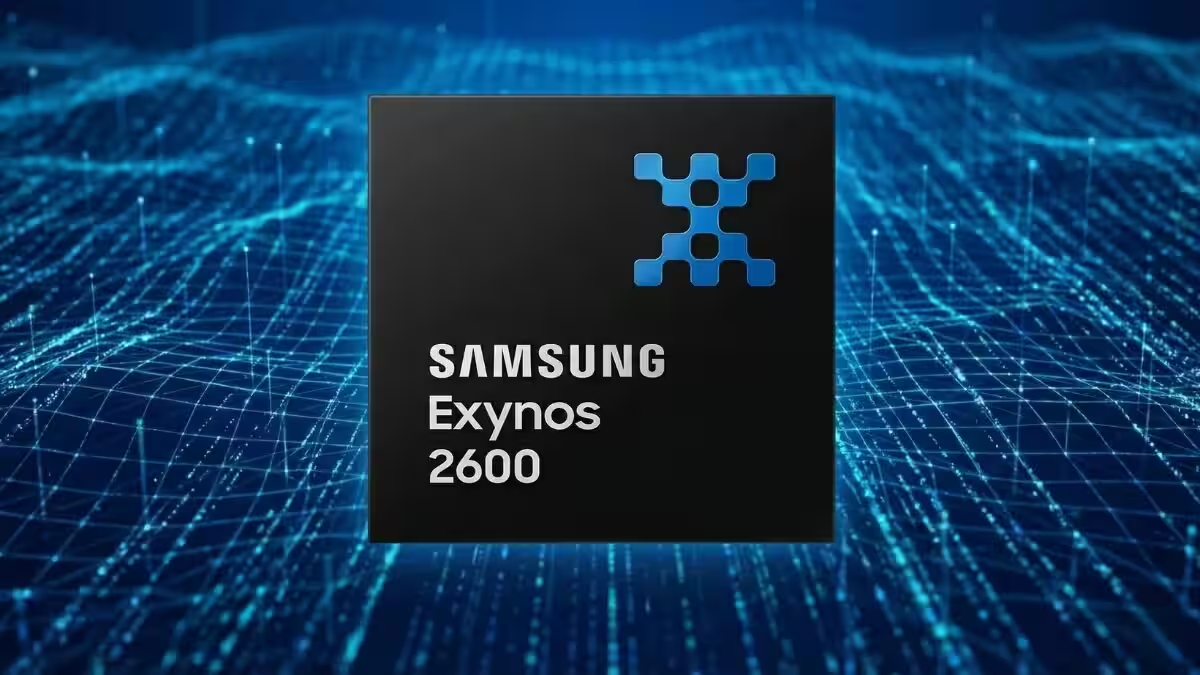
The move coincides with preparations for Samsung’s future flagship chips, including the recently unveiled Exynos 2600, built on a 2nm process. While Rayfield’s impact will not be immediately apparent, his appointment shows Samsung’s serious intentions to strengthen its Exynos lineup and reduce its dependence on Qualcomm in the long term.
For Galaxy users, this potentially means more stable and consistent device performance across regions, but the real results probably won’t show up until several product generations later.